
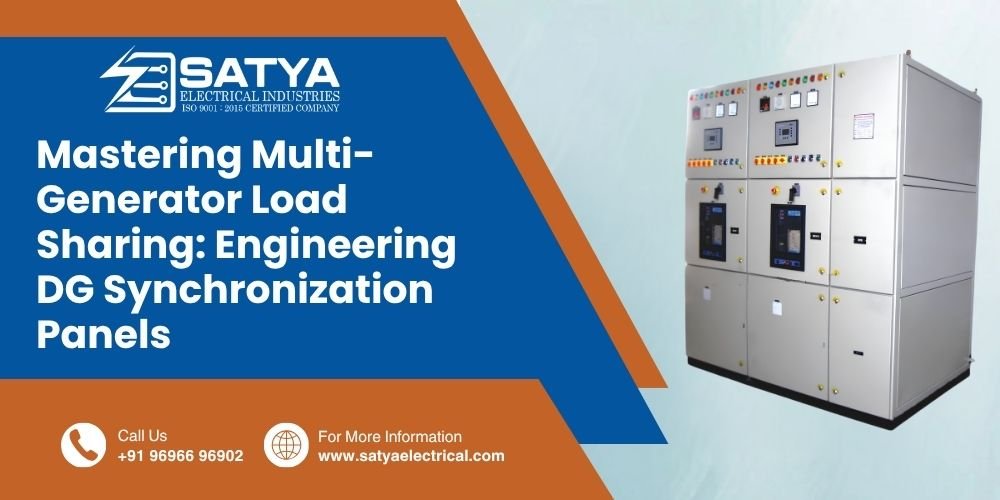
For heavy industrial processing plants, hospital complexes, data centers, and continuous process manufacturing lines, a single standby Diesel Generator (DG) set is rarely enough to cover multi-megawatt backup requirements. Relying on one massive generator is both inefficient during low-load periods and creates a single point of operational failure.
The engineering standard for flexible backup infrastructure is Multi-Generator Paralleling. By running two, three, or more smaller generators connected to a shared busbar, facilities can scale emergency power dynamically as electrical demand fluctuates.
The control brain behind this parallel network is the DG Synch Panel (Synchronization Board).
Paralleling AC power sources requires microsecond-level synchronization. If two generators are tied together when their sine waves are out of step, the resulting voltage differential acts as a dead short circuit, producing massive mechanical stress that can snap engine crankshafts and tear alternator windings apart.
The Four Physics Rules of AC Parallel Switching
Before an automated controller in a DG Synch Panel can send a close signal to a generator’s motorized breaker or MCCB Panel, four physical parameters between the incoming generator and the live busbar must match precisely:
      [ Main Synch Busbar: 415V / 50Hz / 0° Phase Shift ]
                                 ||
           (Synch Check Relay & PLC Controller Guard)
                                 ||
==========================================================================
| Phase Order: R-Y-B  | Voltage Delta: < 1% | Freq Delta: < 0.1Hz |
                          Phase Shift: < 5° |
==========================================================================
                                 ||
    [ Motorized Air Circuit Breaker / MCCB - Incoming DG Set ]
Phase Sequence Match: Both the busbar and incoming generator must rotate in the exact same phase sequence (R → Y → B). A mismatched sequence causes an instantaneous phase-to-phase short circuit.
- Voltage Amplitude Equality: The terminal voltage of the incoming alternator must match the busbar voltage (typically within ±1%). A voltage imbalance forces reactive current (kVAR) to circulate between alternators, overheating their copper windings.
- Frequency Matching: The engine speeds must be trimmed until the incoming frequency matches the busbar frequency (typically within ± 0.1 Hz).
- Phase Angle Alignment: The sine waves must cross zero simultaneously (phase angle difference less than 5°). This is the critical threshold guarded by automatic synchronizing relays.
Real vs. Reactive Power Distribution: kW and kVAR Load Sharing
Once multiple DGs are locked onto the central Bus Bar Chamber, the DG Synch Panel must continually balance the electrical load across all running engines so that no single unit gets overloaded while others idle.
- Active Power Load Sharing (kW): Managed by regulating the engine fuel governors. If Generator 1 starts carrying too much real load, the synchronization controller signals its Electronic Governor to notch down fuel delivery slightly while signaling Generator 2’s governor to throttle up.
- Reactive Power Load Sharing (kVAR): Managed by adjusting the Automatic Voltage Regulator (AVR) field excitation currents. Proper kVAR sharing ensures balanced inductive currents without causing cross-circulating currents between alternators.
Essential Safety Protection Loops inside Synch Panels
To protect multi-million-rupee generator investments, high-performance synchronization boards integrate rigid protective relaying:
| Protective Relay Loop | ANSI Code | Operational Hazard Prevented |
| Reverse Power Protection | 32 | Prevents a failing generator from motoring (drawing power from the busbar to spin its engine), avoiding internal engine destruction. |
| Cross-Current / Voltage Match | 40 / 27 | Drops the incoming breaker if excitation fails or voltage sags drastically. |
| Synch-Check Guard | 25 | Physically blocks breaker closure if phase angle or frequency drift exceeds safety margins. |
| Vector Shift / Rate of Change | 78 / 81R | Detects sudden grid drops during closed-transition peak-shaving operations. |
Operational Planning Tip: Modern DG Synch Panels feature Automatic Demand-Dependent Start/Stop routines. During low night-shift loads, the panel automatically shuts down two out of three DGs to run the remaining engine at its peak thermal efficiency (75-80% load profile), drastically reducing diesel fuel consumption and preventing engine carbon buildup (wet stacking).
Deploy High-Reliability Power Paralleling Systems
Designing multi-generator synchronization infrastructure demands deep PLC programming expertise, precision busbar fabrication, and rigorous protective relay calibration. Relying on unvetted controls or manual changeover boards exposes your critical generation assets to catastrophic electrical flashovers and mechanical shaft shearing.
As a leading manufacturer, supplier, and exporter, Satya Electrical builds heavy-duty DG Synch Panels, AMF Panels, ATS Panels, Motorized MCCB Boards, and Custom Bus Bar Chambers tailored to handle your facility’s exact fault ratings and generation capacities.

 Users Today : 3
 Users This Month : 113
 Total Users : 1326