
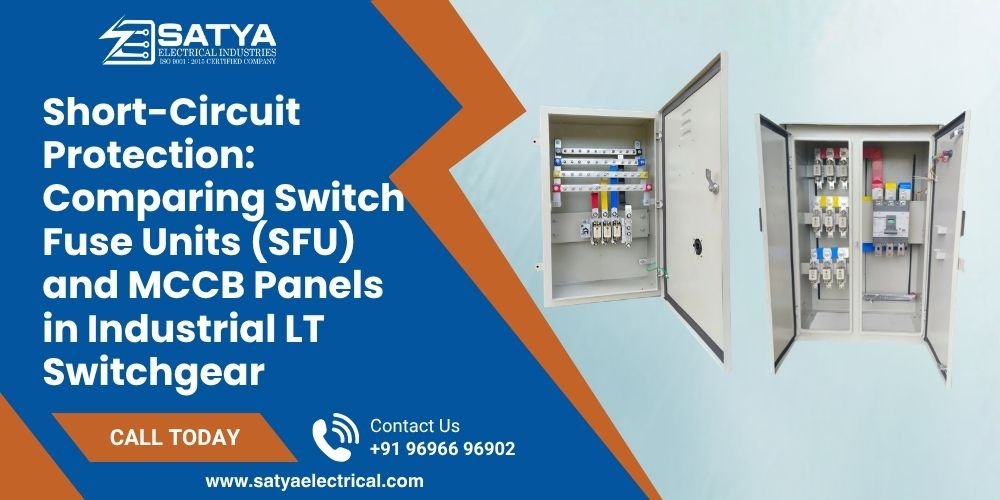
In any industrial power distribution network, the primary duty of low-voltage (LT) protective switchgear is simple: interrupt massive fault currents before they cause explosive arc flashes, burn copper busbars, or destroy downstream motor drives.
When designing main distribution boards, motor feeders, or localized control panels, project engineers routinely face a core switchgear selection decision: specifying a traditional Switch Fuse Unit (SFU) or installing a modern Molded Case Circuit Breaker (MCCB Panel).
While both devices serve to isolate electrical faults, their underlying mechanics, thermal recovery speeds, and operational costs differ fundamentally. Choosing the wrong device can lead to unnecessary motor burnouts, expensive downtime, or compromised short-circuit breaking capacity.
Mechanical Operation: Fused Breaking vs. Thermal-Magnetic Tripping
Understanding the metallurgical and mechanical differences between these two technologies is essential for precise switchgear selection:
Switch Fuse Unit (SFU): Combines a heavy-duty manual double-break knife switch with high-rupturing capacity (HRC) fuses in series. When a short circuit occurs, the silver fuse element inside the HRC cartridge melts instantly, extinguishing the arc within a quarter-cycle.
The Major Advantage: Exceptional current-limiting performance and high short-circuit breaking capacity (up to 80 kA or 100kA) at a fraction of the cost of large electronic breakers.
The Operational Drawback: Fuse replacement requires manual downtime. Furthermore, if only one phase fuse blows during a fault, the remaining two phases can continue supplying partial power to a three-phase motor—causing a destructive single-phasing fault that burns motor windings unless secondary single-phasing preventers are installed.
Molded Case Circuit Breaker (MCCB): Employs an integrated thermal-magnetic or microprocessor-based electronic trip unit driving a spring-loaded mechanical contact assembly inside a molded insulating frame.
The Major Advantage: Simultaneous 3-pole or 4-pole opening eliminates single-phasing risks entirely. Additionally, modern MCCBs offer adjustable trip settings (0.4 x In to 1.0 x In), short-time delay adjustments (I2t), and instant mechanical reset capability without needing replacement parts.
Comparative Performance Matrix
       [ Short Circuit Fault Occurs on Downstream Feeder ]
                              ||
           /----------------------------------\
          ||                                  ||
[ Switch Fuse Unit (SFU) ]               [ MCCB Panel ]
- Element Melts in < 5ms               - Trip Unit Sense & Unlatches
- Single Phase May Blow                - All 3/4 Poles Open Simultaneously
- Manual Fuse Cartridge                - Instant Toggle Reset
  Replacement Required                   After Fault Cleared
To make an informed procurement decision, panel builders and facility managers must evaluate both technologies against key operational parameters:
| Engineering Parameter | Switch Fuse Unit (SFU) | Molded Case Circuit Breaker (MCCB) |
| Short-Circuit Breaking Capacity | Very High (up to 80kA – 100kA with HRC fuses) | Standard (25kA – 50kA); High-kA models carry higher costs |
| Trip Setting Flexibility | Fixed (dictated strictly by the installed fuse rating) | Fully Adjustable (electronic Microprocessor / Thermal-Magnetic) |
| Downtime After Fault | High (must source and physically replace blown HRC fuses) | Low (instant manual or motorized handle reset) |
| Single-Phasing Protection | Requires auxiliary Single Phasing Preventer (SPP) relay | Native (all poles trip simultaneously on any single-phase fault) |
| Initial Procurement Cost | Cost-effective for fixed heavy industrial loads | Higher initial investment, offset by lower long-term O&M costs |
Strategic Application Zoning in Industrial Plants
Rather than treating SFUs and MCCBs as strictly competing products, leading electrical consultants deploy them strategically across different tiers of the power tree:
- Heavy Constant Loads & Service Entrances (SFU Ideal Zone)
In heavy industrial yards, furnace lines, and main utility feeds where prospective fault currents exceed 65 kA, heavy-duty Switch Fuse Units provide unmatched current-limiting safety. The HRC fuse clears extreme short circuits so rapidly that the total let-through energy (I2t) passing downstream to main Bus Bar Chambers is significantly reduced.
- Variable Motor Drives & Dynamic Sub-Feeders (MCCB Ideal Zone)
For sub-distribution networks feeding VFD Panels, automated machinery, or multi-circuit process lines, MCCB Panels are the gold standard. Their adjustable short-delay settings allow engineers to tune trip curves above motor starting inrush currents while ensuring rapid isolation during genuine short circuits—minimizing plant downtime and eliminating single-phasing motor failures.
Switchgear Assembly Tip: When mounting heavy Switch Fuse Units or MCCB assemblies inside compact LT Panels, always verify that terminal spreaders and insulated phase barriers are installed between line and load terminals. Overlooking phase barriers allows ionized gases generated during arc interruption to bridge adjacent terminals, resulting in catastrophic phase-to-phase flashovers inside the panel enclosure.
Source High-Performance, Certified Switchgear Assemblies
Engineering reliable low-voltage distribution networks demands strictly tested breaking devices, high-purity copper busbar connections, and rigid enclosure manufacturing. Installing under-rated breakers or poor-quality fuse bases risks contact welding, localized fires, and severe operational shutdowns.
As an ISO-certified manufacturer, supplier, and exporter, Satya Electrical produces heavy-duty Switch Fuse Units, MCCB Panels, LT Distribution Switchgear, Bus Bar Chambers, and Enclosure Accessories. Every unit is built to withstand high short-circuit kA ratings and strictly complies with international switchgear standards.

 Users Today : 2
 Users This Month : 102
 Total Users : 1315