
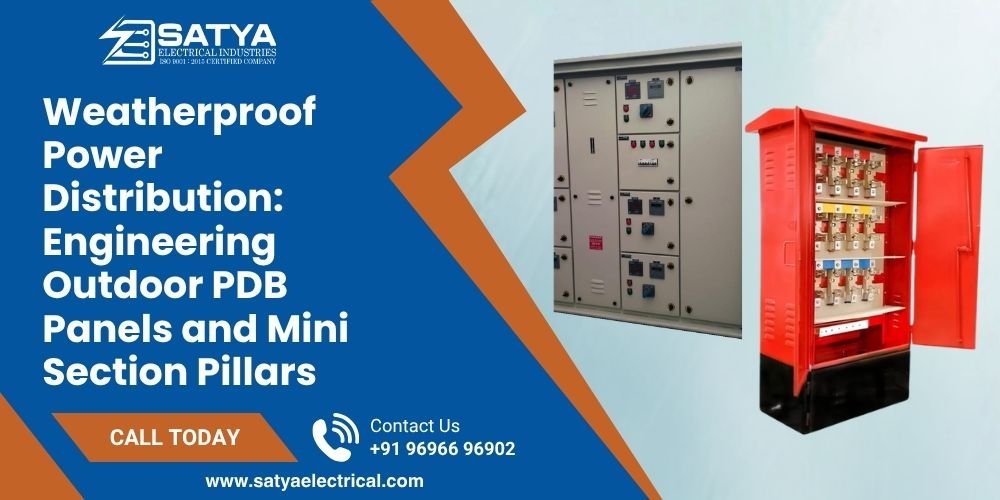
In large-scale industrial manufacturing estates, outdoor yards, municipal infrastructure networks, and commercial real estate hubs, power distribution cannot remain confined to indoor electrical rooms. High-voltage power must be stepped down and split out across open-air environments to feed street lighting networks, Electric Poles, outdoor machinery, subterranean pumps, and peripheral utility grids.
This open-air sub-distribution relies on two essential workhorses: Outdoor Power Distribution Boards (PDB Panels) and ground-mounted Mini Section Pillars.
Because these units operate fully exposed to extreme monsoons, blowing dust, intense ambient UV radiation, and physical tampering, designing them requires a radically different engineering approach than standard indoor panels. A minor sealant flaw or improper breathing vent layout will quickly lead to water accumulation, phase-to-phase short circuits, and localized power outages.
Environmental Enclosure Defense: Deciphering Ingress Protection (IP) Ratings
                   [ Outdoor Rain / Dust Storm Pressure ]
                                    ||
     ================================================================
     |   Double-Flanged Door Channel with Continuous EPDM Gasket    |
     |   [ Outer Weatherproof Canopy / Slope Roof (15° Incline) ]   |
     ================================================================
               ||                                         ||
               \/                                         \/
     [ IP65 Sealed Compartment ]                [ Louvered Air Vent ]
     - Main Bus Bar Chamber                     - Wire Mesh (Insect Proof)
     - Switch Fuse Units / MCCBs                - Anti-Condensation Heater
- IP55 (Standard Outdoor Yard Minimum): Protects against harmful dust accumulation and water jets projected by a nozzle from any direction.
- IP65 (Heavy Monsoon & Washdown Zones): Complete protection against dust ingress and resistance to heavy seas or powerful water jets. This rating requires continuous polyurethane (PU) foam gasketing along all door seams and double-flanged frame channels that divert water away from the door seal.
- Sloped Weather Canopy: Every outdoor Mini Section Pillar and Outdoor PDB Panel must feature a sloped top overhang (typically angled at 15°) to prevent standing rainwater from pooling on top of the enclosure, which drastically reduces rust formation over time.
Managing Internal Condensation and Ground Moisture Seepage
A major cause of electrical failure in outdoor section pillars isn’t rain falling from above—it’s moisture rising from the soil below.
When a ground-mounted pillar sits over an open concrete cable trench, warm ground humidity rises into the cool metal enclosure at night. As the ambient temperature drops, this moisture condenses directly onto bare copper busbars, Switch Fuse Units, and breaker terminals, leading to rapid arc tracking and insulator flashovers.
To prevent subterranean moisture damage, engineers must enforce three key installation protocols:
- Gland Plate Cable Sealing: Incoming power cables routed from underground Perforated GI Cable Trays or direct-buried conduits must pass through a removable bottom gland plate sealed with weather-tight brass cable glands and fire-retardant compound.
- Thermostatically Controlled Anti-Condensation Heaters: Installing a compact 40W – 80W space heater wired through an internal hygrostat ensures the interior air temperature stays slightly above the dew point, eliminating internal moisture formation.
- Raised Plinth Clearance: Mini section pillars must be bolted onto a raised concrete foundation pad elevating the bottom of the enclosure at least 300mm above ground level to prevent water ingress during localized flooding.
Critical Engineering Parameters for Outdoor Pillars
To guarantee decades of continuous field operation, outdoor distribution hardware must adhere to the following physical and electrical standards:
| Design Parameter | Minimum Industrial Requirement | Field Reliability Goal |
| Sheet Steel Thickness | 14 SWG (2.0mm) CRCA or Galvanized Steel | Provides structural resistance against impact, wind loading, and frame warping. |
| Surface Coating Spec | Pure Polyester Outdoor Grade Powder Coating (80-100 μm) | Resists UV chalking, color fading, and salt-spray corrosion in open environments. |
| Incoming Control Gear</b | Heavy-Duty Switch Fuse Unit (SFU) or MCCB Panel | Provides positive isolation and high-kA fault breaking for downstream circuits. |
| Access Hardware | Three-Point Cam Lock mechanism with padlockable hasp | Prevents unauthorized access, copper theft, and accidental public contact. |
Field Mounting Tip: When mounting smaller Outdoor PDB Panels directly onto structural H-Beams or concrete utility columns, avoid welding directly to the panel frame. Use heavy-gauge, hot-dip galvanized GI L Clamps or customized U-bolt support assemblies to maintain the structural integrity of the panel’s protective powder coating.
Partner with an ISO-Certified Switchgear Manufacturer & Exporter
Designing durable, weather-tested outdoor distribution networks requires precision sheet metal fabrication, specialized gasket sealing, and rigorous IP testing. Choosing lightweight indoor enclosures or unvetted outdoor boxes exposes your remote utility assets to severe weather degradation, public safety hazards, and frequent power outages.
As a trusted manufacturer, supplier, and exporter, Satya Electrical builds heavy-duty Outdoor PDB Panels, Mini Section Pillars, Switch Fuse Units, LT Panels, and Enclosure Accessories. Our products are engineered strictly to handle aggressive monsoon conditions, dust storms, and heavy industrial usage.

 Users Today : 3
 Users This Month : 113
 Total Users : 1326