
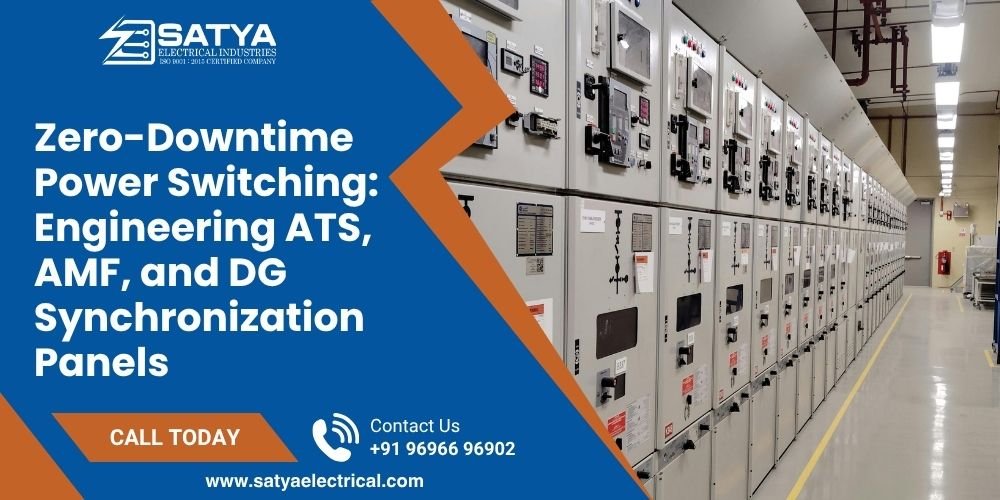
For industrial manufacturing plants, continuous process industries, data hubs, and commercial centers, a power blackout isn’t just an inconvenience—it’s an operational disaster. A sudden voltage loss on an active production floor can freeze extrusion lines, ruin chemical batches, and cause massive financial losses within minutes.
To guarantee continuous power, facilities deploy dual-source networks backed by standby Diesel Generator (DG) sets. However, the reliability of this emergency power loop depends entirely on the intelligence and mechanical integrity of the control switchgear: the AMF Panel (Auto Mains Failure), the ATS Panel (Automatic Transfer Switch), and the DG Synch Panel (Synchronization Board).
Designing these panels requires strict adherence to switching speeds, mechanical interlocking safety barriers, and phase synchronization protocols. A failure in any of these components can cause fatal grid back-feeding or destruction of generator alternators.
The Switching Hierarchy: AMF vs. ATS vs. DG Synchronization
| Control Panel Architecture | Primary Functional Role | Typical Load Application | Sizing Focus |
| AMF Panel | Monitors grid health, issues auto-crank signal to DG, and closes contactor when generator voltage stabilizes. | Single DG backup setups for industrial plants and commercial buildings. | Timer relays, battery charger float circuits, and engine parameter monitoring. |
| ATS Panel | Automatically transfers connected load circuits between two live sources (Grid 1 vs. Grid 2 or Grid vs. DG). | Sub-distribution networks, hospital emergency wings, and processing lines. | High-speed motorized 4-Pole AC3-rated changeover switches or interlocked MCCBs. |
| DG Synch Panel | Matches phase angle, frequency, and voltage across multiple DG sets to run them in parallel on a single bus. | Large industrial complexes requiring dynamic multi-megawatt standby power. | PLC/DeepSea load-sharing modules, motorized ACB breakers, and droop CTs. |
Safety Architecture: The Non-Negotiable Double Interlock
The primary hazard when switching between grid utility power and standby generator supply is accidental paralleling (unless using a specialized, closed-transition DG Synch panel).
If an un-synchronized generator contactor closes while main grid power is active, the massive voltage differential will cause an explosive arc flash, destroying the generator stator and tripping main upstream breakers.
                 [ Main Utility Grid Power Source ]
                                  ||
                  [ Motorized Breaker / MCCB 1 ]
                                  ||
      ============================||============================
      |         ATS Panel Output Busbar (To Plant Load)         |
      ============================||============================
                                  ||
                  [ Motorized Breaker / MCCB 2 ]
                                  ||
                 [ Standby Diesel Generator Source ]

          *(MECHANICAL & ELECTRICAL INTERLOCK BARRIER)*
     (Breaker 1 & Breaker 2 CANNOT close simultaneously at any time)
To eliminate this hazard entirely, leading LT panel manufacturers implement a Dual Interlock Strategy:
- Electrical Interlocking: The close-coil circuit of the Utility breaker routes through an auxiliary Normally Closed (NC) contact on the Generator breaker, and vice versa. One breaker cannot physically energize its closing coil if the other is closed.
- Mechanical Interlocking: A rigid steel lever or heavy-duty mechanical cable linkage physically blocks the mechanism of Breaker 2 from moving to the “ON” position as long as Breaker 1 is engaged. This mechanical barrier operates independently of electrical power, protecting against coil short-circuits or relay welded-contact failures.
Neutral Isolation: Why 4-Pole Switching is mandatory
In dual-source power systems, switching only the three active phase lines (R, Y, B) while keeping a solid, un-switched neutral connection to both grid and generator sources introduces severe operational risks:
- Earth Leakage Relay (ELR) Nuisance Tripping: Unbalanced return currents can split across the shared neutral path, causing false zero-sequence current readings that trip upstream ELR Panels.
- Stray Neutral Voltage: During grid outages, stray currents from neighboring industrial facilities can travel backward along the utility neutral line, posing an electrocution hazard to generator maintenance crews.
For these reasons, high-performance ATS and AMF panels must always utilize 4-Pole (4P) switching devices—ensuring the neutral conductor is isolated simultaneously with all three active phase lines during every transfer sequence.
Engineering Selection Rule: When specifying motorized MCCB panels or changeover switches for ATS duty, always verify that the contacts carry a full AC-33A or AC-33B utilization rating under IEC 60947-6-1. Standard distribution MCCBs designed for infrequent manual operation will experience contact welding under the rapid, high-inrush switching cycles typical of heavy motor-driven industrial plants.
Partner with an ISO-Certified Switchgear Manufacturer & Exporter
Engineering seamless backup power systems requires specialized PLC control programming, certified busbar bending, and rigorous mechanical interlock testing. Choosing under-rated changeovers or poorly wired control panels leaves your critical facility infrastructure vulnerable to extended blackouts and catastrophic back-feeding accidents.
As a leading manufacturer, supplier, and exporter, Satya Electrical designs and fabricates heavy-duty AMF Panels, ATS Panels, DG Synchronization Panels, MCCB Panels, and Custom LT Distribution Switchgear. Every panel is engineered to withstand extreme short-circuit kA ratings and comply with international electrical standards.

 Users Today : 3
 Users This Month : 113
 Total Users : 1326