
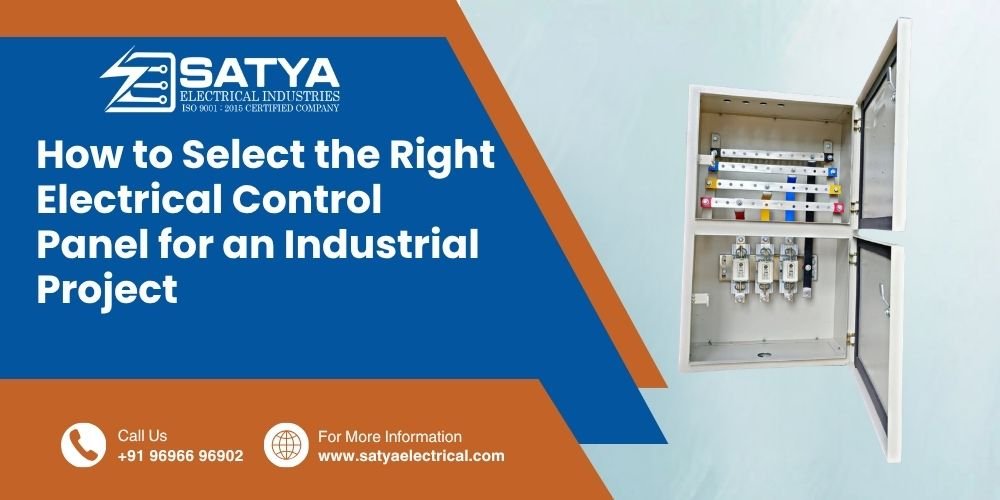
Selecting an industrial electrical control panel is not simply a matter of choosing a cabinet with breakers and switches. The right panel must match the electrical load, equipment, operating environment, protection requirements and future expansion plans of the facility.
A panel designed correctly can make power distribution easier to manage and maintenance more predictable. On the other hand, selecting a panel only by current rating or enclosure size can create problems during installation, operation and future expansion.
For factories, process plants, commercial facilities and infrastructure projects, the selection process should begin with the application rather than the panel name.
1. Start With the Electrical Load
The first step is to understand what the panel will supply.
Prepare a basic load schedule containing:
- Connected load
- Maximum demand
- Motor ratings
- Starting current
- Number of outgoing feeders
- Voltage level
- Phase configuration
- Expected future load
For example, a manufacturing facility operating pumps, conveyors, compressors and production machinery may have very different requirements from a commercial building.
The panel should be designed around the actual electrical system instead of selecting a standard configuration and trying to fit the project into it.
This is particularly important for customized industrial panels where busbar capacity, incoming protection and outgoing feeder arrangements may need to be selected according to the project.
2. Identify the Type of Panel Required
Different applications require different panel configurations.
A VFD panel is generally used when motor speed control, controlled acceleration or process regulation is required. Satya Electrical manufactures VFD panels for applications including manufacturing, HVAC, water treatment and material handling.
An MCCB panel can be used for power distribution and circuit protection where higher current protection and switching capability are required.
A feeder section panel is useful when power needs to be distributed from a main source to multiple downstream loads. It provides organized feeder management and fault isolation.
For larger installations, an LT panel or other customized distribution arrangement may be required depending on the incoming supply and distribution architecture.
The important point is that the panel type should follow the electrical function.
3. Check Voltage and Current Requirements
Voltage and current ratings are fundamental selection parameters.
The manufacturer should know:
- Incoming voltage
- System frequency
- Rated current
- Short-circuit level
- Number of phases
- Incoming breaker rating
- Outgoing breaker ratings
- Busbar material
- Required fault withstand capability
For example, an MCCB panel can be designed across a broad current range. Satya Electrical currently specifies MCCB panel configurations from 63A to 1600A, with customized busbar sizing and multiple protection options.
Avoid selecting a panel simply because its current rating appears higher than the connected load. Proper engineering should also consider fault levels, temperature rise, cable termination requirements and future expansion.
4. Consider Short-Circuit Protection
Short-circuit protection is one of the most important aspects of industrial panel selection.
The panel’s protective devices should be compatible with the expected fault level of the electrical system.
Depending on the application, protection may involve:
- MCBs
- MCCBs
- ACBs
- Fuses
- Overload protection
- Earth-fault protection
- Under-voltage protection
- Over-voltage protection
- Surge protection
The objective is not simply to install more protection devices. The protection system should coordinate with the electrical distribution network so that a fault can be isolated without unnecessarily shutting down unaffected sections.
5. Choose the Correct Enclosure and IP Rating
The installation environment can change the panel specification considerably.
An indoor electrical room may have relatively controlled conditions. An outdoor installation can expose the enclosure to rain, dust, sunlight, humidity and temperature variations.
Outdoor PDB panels, for example, may require higher enclosure protection depending on the installation environment. Satya Electrical lists IP54, IP55 and IP65 configurations for its outdoor PDB panel range.
Before finalizing the enclosure, consider:
- Indoor or outdoor installation
- Dust exposure
- Moisture
- Ambient temperature
- Chemical exposure
- Ventilation
- Accessibility
- Cleaning requirements
The enclosure should protect the electrical equipment without creating unnecessary heat-management problems.
6. Plan the Panel Layout Around Maintenance
A technically correct electrical panel can still be inconvenient if its internal arrangement is poorly planned.
Maintenance teams need adequate access to:
- Breakers
- Contactors
- Relays
- Terminal blocks
- Busbars
- Control wiring
- Cable entry points
- Meters
- Protection devices
Cable routing should be organized so technicians can trace circuits without dismantling unrelated sections.
For larger industrial projects, double-front or compartmentalized configurations may also be considered where the project requires better accessibility or space utilization.
7. Think About Future Expansion
Industrial facilities rarely remain electrically identical for their entire operating life.
New motors, production lines, pumps or automation systems may be added later.
When designing the panel, discuss possible expansion with the manufacturer.
Future planning may include:
- Spare outgoing feeders
- Additional breaker space
- Extra busbar capacity
- Additional cable entry provisions
- Space for meters or communication modules
- PLC or automation expansion
A small amount of planned spare capacity can make future modifications considerably easier.
8. Consider Cable Management Along With the Panel
The electrical panel is only one part of the distribution system.
Cables leaving the panel need an organized route to machines and downstream equipment.
This is where cable tray selection becomes important.
Satya Electrical manufactures GI cable tray and support systems with options including perforated and ladder-type trays. Its cable tray support system is also offered in galvanized configurations for industrial installations.
Panel and cable management should therefore be considered together during project planning.
The number of cables, cable diameter, load, routing distance, environmental exposure and future expansion can all influence the appropriate tray arrangement.
9. Prepare the Right Information Before Requesting a Quote
One of the easiest ways to speed up an electrical panel enquiry is to give the manufacturer enough technical information at the beginning.
A useful enquiry should include:
- Panel type
- Incoming voltage
- Current rating
- Load details
- Single-line diagram, if available
- Number of outgoing feeders
- Breaker requirements
- Short-circuit level
- Indoor or outdoor installation
- Required IP rating
- Busbar preference
- Metering requirements
- Control or automation requirements
- Quantity
- Delivery location
Providing this information helps the manufacturer understand the actual project rather than preparing a generic quotation.
10. Select a Manufacturer Based on the Project, Not Only the Price
Electrical panels are project-specific products. Two panels may look similar externally while having very different internal configurations, protection systems and component selections.
Before placing an order, review:
- Manufacturing capability
- Testing procedures
- Certifications
- Component brands
- Fabrication quality
- Documentation
- Customization capability
- Installation support
- Previous industrial applications
Satya Electrical positions itself as an Ahmedabad-based manufacturer of customized industrial electrical panels and GI cable tray systems, with more than 15 years of manufacturing experience and CPRI-tested product offerings.
Final Checklist for Industrial Electrical Panel Selection
Before finalizing a panel, confirm:
Application: What equipment will the panel control or supply?
Load: What is the connected and maximum demand?
Protection: What fault and protection requirements apply?
Environment: Will the panel be installed indoors or outdoors?
Expansion: Will additional loads be added later?
Layout: Is there sufficient space for operation and maintenance?
Cable management: Are cable routes and tray requirements included?
Documentation: Are drawings, specifications and testing requirements clearly defined?
A well-planned industrial electrical control panel should be selected as part of the complete electrical distribution system rather than as an isolated product. Starting with the load, protection requirements, environment and future expansion makes it easier to define the right configuration and avoid costly changes later.
For industrial projects requiring customized VFD panels, MCCB panels, LT panels, feeder panels, DG synchronization panels or cable management systems, Satya Electrical can evaluate the application and develop a project-specific solution.
Share Your Panel Requirement
Contact our cable management tray and Industrial Control Panel engineering desk today to submit your site layouts or request a bulk quotation

 Users Today : 4
 Users This Month : 285
 Total Users : 1831