
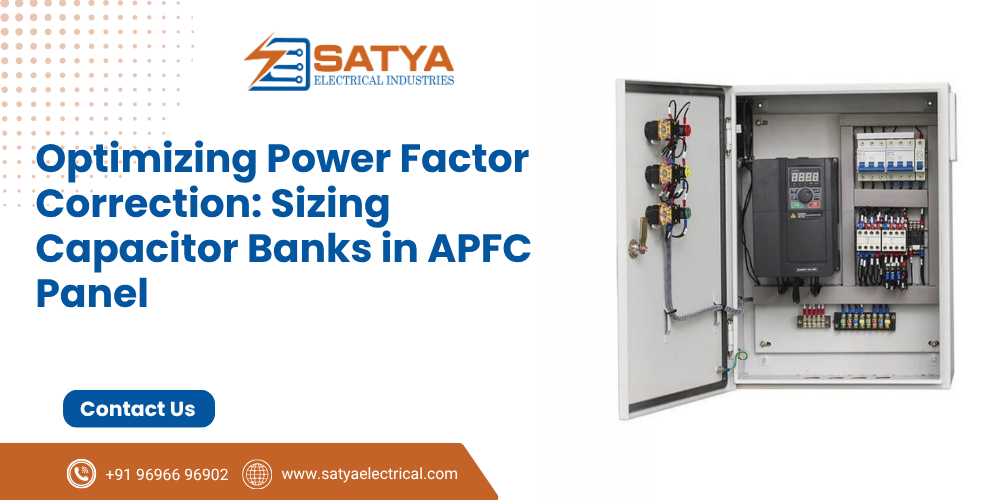
For industrial manufacturing facilities operating heavy inductive loads—such as induction motors, transformers, welding machines, and compressors—maintaining a near-unity power factor (PF ≥ 0.99) is critical.
State electricity distribution companies (DISCOMs) enforce strict billing tariffs. Falling below a 0.90 or 0.95 PF threshold incurs heavy percentage penalties on total energy charges, while maintaining a 0.99 – 1.00 PF qualifies factories for substantial power rebate incentives.
Installing a properly engineered Automatic Power Factor Correction (APFC) Panel is the most effective way to eliminate power factor penalties, reduce reactive power demand (kVAR), and lower overall utility bills
The Cost of Low Power Factor in Manufacturing
                    TOTAL APPARENT POWER (kVA)
                   /--------------------------\
                  /                            \
   ACTIVE POWER (kW)                     REACTIVE POWER (kVAR)
  [Useful Work Output]                 [Wasteful Inductive Load]
Inductive equipment requires reactive power (kVAR) to generate magnetic fields. When reactive demand increases:
- Total kVA Demand Rises: You pay higher peak demand charges to the grid.
- Cable & Transformer Heating: Uncompensated kVAR current flows through your internal distribution cables, causing voltage drops and I2R copper losses.
- DISCOM Surcharge Penalties: Utility meters track lagging power factor and bill penalty surcharges on total kWh/kVAh consumption.
Step-by-Step kVAR Calculation for APFC Sizing
Target kVAR Required = P × (tan θ₁ - tan θ₂)Where:
- P = Total Active Load in kW
- θ1 = cos-1(Existing Power Factor}
- a_2 = \cos^{-1}(\text{Target Power Factor})$
Engineering Calculation Example:
Consider a plastic manufacturing facility operating at a constant active load of 300 kW with an uncorrected power factor of 0.75 Lag. The factory wants to achieve 0.99 Lag to claim DISCOM incentives.
- Find tan θ1 (Existing): θ1= cos-1(0.75) = 41.41 ° x tan(41.41°) = 0.8819
- Find tan θ2 (Target): θ2 = cos-1(0.99) = 8.11° x tan(8.11°) = 0.1425
- Calculate Required kVAR Rating: Required kVAR = 300 x (0.8819 – 0.1425) = 300 x 0.7394 = 221.82 kVAR
Design Recommendation: Select a standard 225 kVAR or 250 kVAR APFC Panel configured with modular stage steps (e.g., 10 kVAR + 15 kVAR + 25 kVAR x 8) to handle dynamic factory load fluctuations smoothly.
Why Standard Capacitor Panels Fail: The Role of Detuned Reactors
In modern manufacturing facilities equipped with Variable Frequency Drives (VFDs), CNC machinery, and UPS systems, non-linear loads introduce harmonic distortion into the electrical network.
Grid Supply ---> [ APFC Panel ] ---> [ Non-Linear Loads (VFDs/Inverters) ]
                            |
           (Harmonic Current Amplification)
                            |
       [ Standard Heavy-Duty Capacitors Burst/Bulge ]
                            |
   FIX: [ Install 7% or 14% Detuned Harmonic Reactors ]
When standard MPP capacitor banks are connected directly to a network containing 5th or 7th order harmonics, parallel resonance occurs. This amplifies harmonic currents, leading to:
- Overheating and bulging of capacitor cans.
- Nuisance tripping of main incomer MCCBs.
- Premature failure of controller relays.
Solution: Always specify Detuned Filtering Reactors (7% tuning factor for 189 Hz blocking or 14% for 134 Hz) connected in series with duty-rated heavy-duty gas-filled or aluminum-can capacitors.
APFC Panel Engineering Specifications Checklist
| Panel Component | Technical Specification Standard |
| Microprocessor Controller | 8-stage or 12-stage Intelligent APFC Controller with auto-sensing CT direction, THD monitoring, and target PF setting. |
| Switching Duty | Special Duty Capacitor Duty Contactors with pre-charge damping resistors to withstand high inrush currents ($>200 \times I_n$). |
| Capacitor Rating | Heavy-Duty Polypropylene (MPP) Self-Healing Type, $440\text{V} / 480\text{V} / 525\text{V}$ rated for over-voltage headroom. |
| Enclosed Ventilation | Forced cooling exhaust fans with washable air filter louvers to maintain internal ambient temperature below $45^\circ\text{C}$. |
| Protection System | Individual stage HRC fuse backup or dedicated MCCB protection per capacitor-reactor bank. |

 Users Today : 6
 Users This Month : 287
 Total Users : 1833