
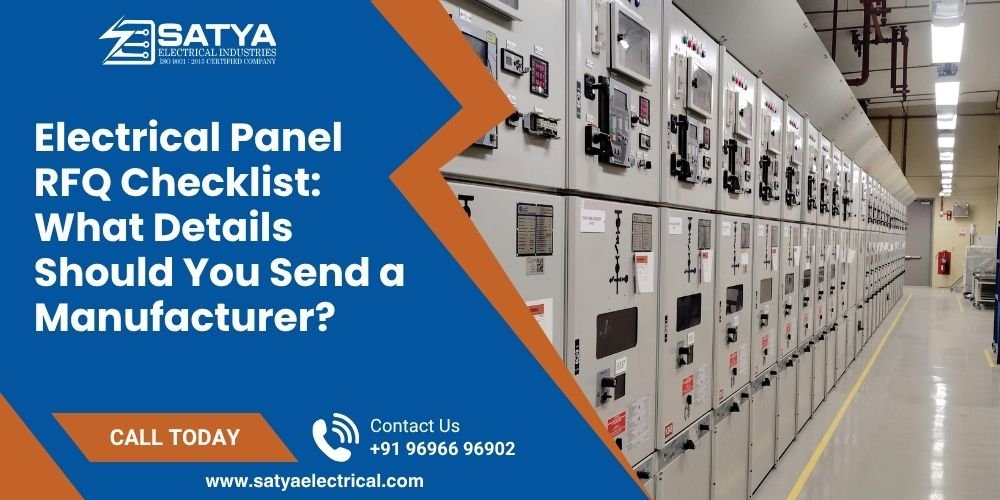
When requesting a quotation for an industrial electrical panel, sending only the panel name is rarely enough. A manufacturer needs technical and project information to understand the application, select suitable components and prepare an accurate quotation.
A clear electrical panel RFQ can reduce repeated communication, prevent specification gaps and help manufacturers provide a quotation that matches the actual project requirement.
Whether you are a factory owner, EPC contractor, consultant, purchase manager or electrical engineer, the following checklist can help you prepare a better panel enquiry.
1. Mention the Required Panel Type
Start your RFQ by clearly stating what type of panel you require.
Depending on the application, this could include:
- LT panel
- MCCB panel
- VFD panel
- Feeder panel
- AMF panel
- DG synchronization panel
- Power distribution panel
- Automation panel
- Outdoor PDB
- Customized control panel
If the exact panel type has not been finalized, explain the application instead. A manufacturer can then review the requirement and suggest a suitable configuration.
For example, instead of simply writing “control panel required,” mention whether the panel will operate pumps, motors, production equipment, HVAC systems or another industrial process.
A useful electrical panel quotation should make it possible to compare technical and commercial details.
Ask the manufacturer to clearly mention:
- Panel configuration
- Rated current
- Enclosure details
- Major components
- Component brands
- Protection devices
- Metering
- Testing
- Documentation
- Warranty
- Delivery period
- Installation charges, if applicable
- Taxes and freight, where relevant
Avoid comparing quotations only by the final price. Two quotations with similar-looking panel descriptions may contain different components, ratings, documentation and services.
2. Provide the Incoming Supply Details
The incoming electrical supply is one of the most important parts of an electrical panel quotation.
Include details such as:
- Incoming voltage
- Number of phases
- Frequency
- Incoming current
- Transformer capacity, if applicable
- Available short-circuit level
- Incoming breaker requirement
For an industrial project, these details help determine the appropriate incoming switching and protection arrangement.
If a single-line diagram is available, attach it with the RFQ. It can provide much more useful information than a short written description.
3. Share the Connected Load
The manufacturer also needs to understand what the panel will supply.
Prepare a load schedule containing information such as:
| Load Information | Example |
|---|---|
| Equipment | Motor / Pump / Machine |
| Quantity | 4 |
| Motor Rating | 15 kW |
| Voltage | 415 V |
| Starting Method | DOL / Star-Delta / VFD |
| Full Load Current | As applicable |
| Duty | Continuous / Intermittent |
For larger projects, provide the complete equipment load list rather than only the total connected load.
This allows the panel configuration to be developed around the actual distribution requirements.
4. Specify the Outgoing Feeders
An RFQ should clearly mention how many outgoing circuits are required.
For example:
- 4 × motor feeders
- 6 × utility feeders
- 2 × spare feeders
- 1 × lighting feeder
- 1 × pump feeder
Where possible, include the required breaker rating for each outgoing feeder.
If the final feeder schedule is not available, mention the expected number and approximate load. This gives the manufacturer a starting point for preparing the quotation.
5. Mention Protection Requirements
Different industrial applications may require different protection arrangements.
Your RFQ can specify requirements for:
- MCB
- MCCB
- ACB
- Overload protection
- Short-circuit protection
- Earth-fault protection
- Under-voltage protection
- Over-voltage protection
- Surge protection
- Motor protection
You should also mention any preferred protection-device manufacturer if the project specification requires a particular brand.
If the brand is not mandatory, the RFQ can instead specify the required technical characteristics and ask the manufacturer to propose suitable components.
6. Define the Enclosure Requirement
The installation environment can influence the panel enclosure.
Tell the manufacturer whether the panel will be installed:
- Inside an electrical room
- Inside a production area
- Outdoors
- Near machinery
- In a dusty environment
- In a humid area
- In an area exposed to weather
Also specify the required IP rating if it has already been defined by the project.
For outdoor installations, additional requirements may need to be considered for environmental protection, cable entry and enclosure construction.
7. Include Panel Dimensions and Installation Restrictions
Space limitations are easy to overlook during the quotation stage.
If the panel has to fit into an existing electrical room, provide the available:
- Width
- Height
- Depth
- Installation clearance
- Cable entry location
- Door access requirements
Photographs of the proposed installation location can also help when the project involves replacement or modification of an existing panel.
This information can prevent a situation where the quoted panel meets the electrical requirements but cannot be installed in the available space.
8. Specify Metering and Indication Requirements
Tell the manufacturer what information needs to be displayed or monitored from the panel.
Possible requirements include:
- Ammeter
- Voltmeter
- Multifunction meter
- Energy meter
- Frequency indication
- Power factor indication
- Run/trip indication
- Alarm indication
- Communication interface
For automated systems, also mention whether PLC, HMI, communication or remote monitoring requirements are involved.
9. Attach the Single-Line Diagram and Technical Documents
If your project already has engineering documentation, include it with the RFQ.
Useful documents may include:
- Single-line diagram
- Load schedule
- Electrical schematic
- Equipment datasheets
- Panel GA requirements
- Cable schedule
- Project specifications
- Tender documents
- Approved component list
These documents help the manufacturer understand the complete requirement instead of making assumptions.
If the project is still at an early stage, simply state which information is available and which items are yet to be finalized.
10. Mention Testing and Documentation Requirements
The quotation should make clear whether specific testing or documentation is required.
Depending on the project, this may include:
- Routine testing
- Inspection reports
- Test certificates
- Wiring diagrams
- General arrangement drawings
- Bill of materials
- Operation manuals
- Component datasheets
- Quality documentation
For projects involving consultants, EPC contractors or institutional buyers, documentation requirements can be just as important as the physical panel.
11. State Quantity and Delivery Location
Always include the required quantity.
Also mention:
- Delivery location
- Required delivery timeline
- Installation requirement
- Commissioning requirement
- Site support requirement
For example, a manufacturer may quote differently when the requirement includes only panel manufacturing compared with manufacturing, delivery, installation and commissioning.
12. Ask for a Detailed Quotation
A useful electrical panel quotation should make it possible to compare technical and commercial details.
Ask the manufacturer to clearly mention:
- Panel configuration
- Rated current
- Enclosure details
- Major components
- Component brands
- Protection devices
- Metering
- Testing
- Documentation
- Warranty
- Delivery period
- Installation charges, if applicable
- Taxes and freight, where relevant
Avoid comparing quotations only by the final price. Two quotations with similar-looking panel descriptions may contain different components, ratings, documentation and services.
Electrical Panel RFQ Checklist
- Panel type
- Incoming voltage
- Current requirement
- Connected load
- Outgoing feeder details
- Protection requirements
- IP rating
- Installation environment
- Panel dimensions or space restrictions
- Metering requirements
- Single-line diagram
- Load schedule
- Component preferences
- Testing requirements
- Documentation requirements
- Quantity
- Delivery location
- Installation or commissioning requirement
Get a Project-Specific Electrical Panel Quotation
Share Your Panel Requirement
Contact our cable management tray and Industrial Control Panel engineering desk today to submit your site layouts or request a bulk quotation

 Users Today : 1
 Users This Month : 266
 Total Users : 1812