
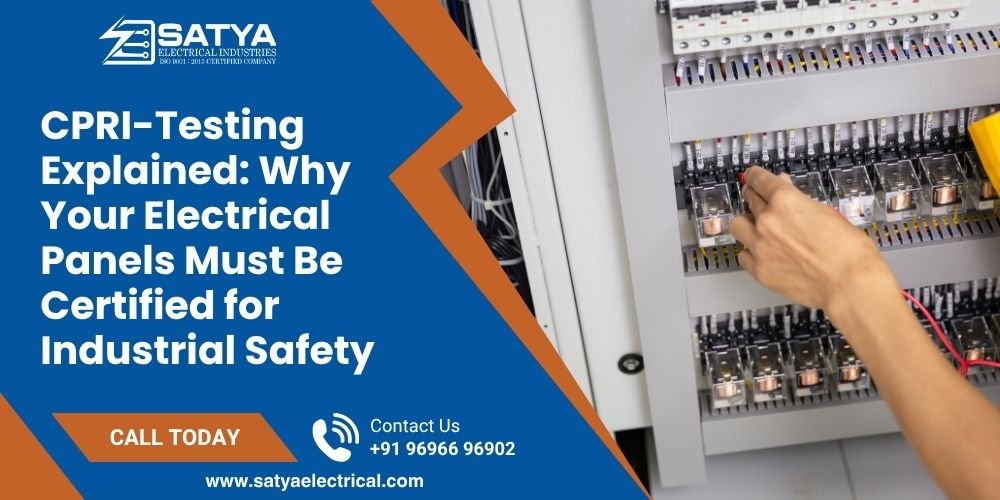
In high-voltage and low-tension (LT) industrial power networks, electrical panels act as the control centers for your entire operational infrastructure. They house the critical switchgear tasked with routing power and isolating faults. When a severe short circuit occurs, currents can spike to thousands of amperes in a fraction of a second, releasing explosive mechanical forces and extreme thermal energy.
If your Feeder Section Panel, VFD Panel, or main distribution board is constructed using unverified methods, it can rupture violently under fault conditions—causing catastrophic property damage, lengthy downtime, and life-threatening injuries.
To prevent these hazards, national regulatory frameworks and strict electrical consultants mandate the use of CPRI-Tested Electrical Panels. Certified by the Central Power Research Institute (CPRI), these assemblies undergo independent, rigorous validation to guarantee they can survive real-world industrial electrical emergencies.
What is CPRI Testing? Understanding Type Tests vs. Routine Tests
CPRI testing is an rigorous, independent certification process conducted at specialized laboratory facilities. Unlike standard routine factory testing—which confirms simple wiring continuity and baseline operational safety—CPRI testing involves subjecting a sample panel to destructive forces to confirm its design limits.
An assembly that passes these protocols becomes a officially certified Type-Tested Switchgear Panel under strict international design framework codes like IEC 61439-1 & 2.
The Core CPRI Type Tests That Verify Panel Safety
1. Short-Circuit Withstand Test (Thermal & Mechanical Stress)
This is the most critical destructive test. The panel’s Bus Bar Chamber and internal supports are subjected to an intentionally engineered short-circuit fault matching its rated capacity (e.g., 50 kA for 1 second).
The test verifies that the copper or aluminum bars will not bend or warp out of shape, and that the insulator supports will not shatter under the magnetic repulsion forces generated by the fault current.
2. Temperature Rise Test (Thermal Equilibrium Verification)
The panel is run continuously at its maximum rated current capacity until its internal temperatures stabilize. Engineers measure individual joints, breaker lugs, and copper busbar links to ensure the localized heat generation stays strictly below safe limits (typically a maximum rise of 70°C over ambient temperatures).
Exceeding these limits causes insulation breakdown, rapid metal oxidation, and eventually leads to dangerous thermal runaway.
3. Dielectric Properties Evaluation (Insulation Integrity)
Technical Evaluation Matrix: Certified vs. Uncertified Panels
| Performance Metric | Generic Fabricated Panel | CPRI-Tested & Certified Panel |
|---|---|---|
| Design Compliance | Approximated or guessed layouts | Strictly adheres to IEC 61439 design standards |
| Short-Circuit Protection | Unverified; prone to structural buckling | Proven to withstand rated kA faults (e.g., 50kA/1s) |
| Insurance & Govt. Tenders | Frequently rejected by compliance auditors | Approved for government tenders & corporate audits |
| Insulation & Support Safety | Prone to degradation under continuous loads | Verified clearances prevent long-term tracking faults |
Overcoming Compliance Friction in Commercial Projects
Procurement Engineering Rule: When bidding for major government projects, public sector undertakings (PSUs), or high-end private infrastructure jobs, an uncertified electrical panel will cause your entire bid to be disqualified instantly. Always specify and source pre-vetted, type-tested panels with formal CPRI documentation to guarantee your project sails smoothly through regulatory clearance.
Deploy Vetted, High-Protection Electrical Infrastructure
Operating an uncertified main panel risks your entire facility’s safety. Cutting corners on testing verification exposes your plant assets, electrical links, and personnel to extreme operational hazards.
At Satya Electrical, we design and manufacture high-performance CPRI-Tested Electrical Panels, Custom Control Assemblies, and Heavy-Duty Distribution Boards tailored to your precise short-circuit capacity and site safety criteria.
Looking for a Reliable Electric Panel Manufacturer?
Reach out to our panel manufacturing cell today to request a technical layout quote or schedule an infrastructure upgrade review.

 Users Today : 3
 Users This Month : 103
 Total Users : 1316