
When deploying heavy-duty cabling systems in processing facilities, power distribution plants, or marine infrastructure, selecting a Cable Tray & Support System isn’t simply a matter of picking a profile dimension. The true deciding factor for system longevity lies in the chemical finish: Pre-Galvanized (PG) vs. Hot-Dip Galvanized after Fabrication (HDG).
An incorrect metallurgical selection risks premature corrosion, structural deflection, and complete system failure, requiring costly downtime and repairs.
The Chemistry: How Coating Processes Differ
Understanding the physical differences in how these protective zinc layers are applied highlights why they perform differently under industrial environmental stress:
- Pre-Galvanized (Mill Galvanized): Steel sheets are run through a continuous molten zinc bath at the mill before being stamped, cut, and shaped into trays.
- Hot-Dip Galvanized (HDG): Mild steel sheets are fully cut, punched into a Perforated GI Cable Tray or welded into a Ladder Tray, and subsequently submerged into a bath of molten zinc. This creates an un-broken metallurgical bond over all raw cut edges, punch holes, and structural welds.
Critical Technical Comparison: PG vs. HDG
| Technical Metric | Pre-Galvanized (PG) | Hot-Dip Galvanized (HDG) |
| Coating Thickness | 15 to 20 Microns per side | 65 to 85+ Microns (All surfaces) |
| Raw Edge Protection | Lacks zinc barrier on stamped cuts | Complete envelope across cuts & welds |
| Best Suited For | Clean indoor, dry commercial zones | Outdoor, chemical, coastal, & wet plants |
| Relative Initial Cost | Baseline | Moderate premium |
The Problem with Edge Oxidation and Support Infrastructure
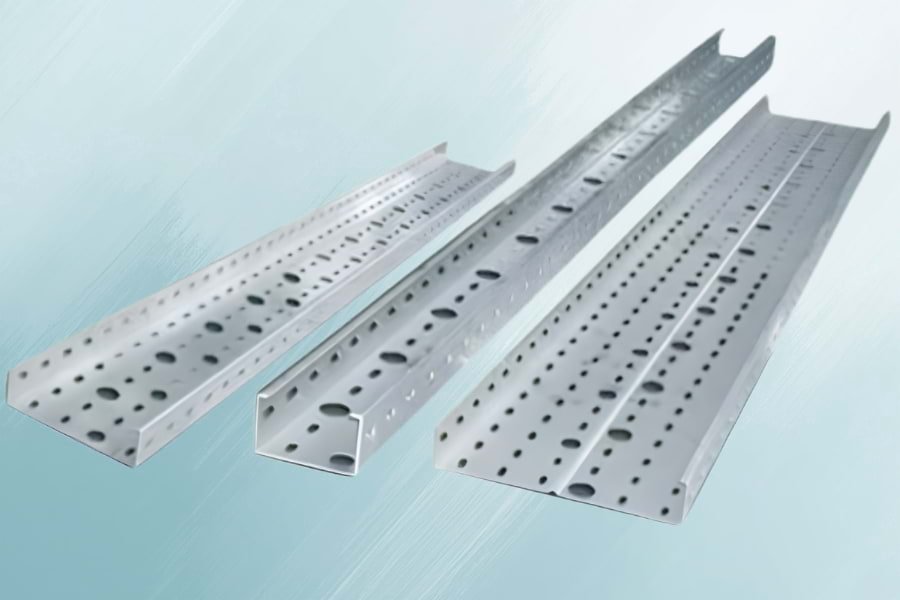
When a perforated tray or Raceway Cable Tray is manufactured from pre-galvanized sheets, the punch patterns and shearing actions expose bare steel edges. While zinc possesses self-healing galvanic properties across minimal scratches, it cannot fully defend continuous bare edges in highly humid or chemical-laden environments.
Furthermore, a heavy cabling run is only as dependable as the supporting framing network. Utilizing high-performance trays with substandard support components leads to systemic failure.
Overhead distribution structures must utilize matching high-micron finishes across all structural accessories, including:
- G.I. Slotted C Channel and G.I. Z Channel structures
- Hanging Threaded Rods and GI L Clamps
- Anchor Bullet Fasteners and heavy-duty Nut Bolt Washers
Application Blueprint: Making the Right Engineering Decision
Choose Pre-Galvanized Systems (PG) if:
- The installation is contained within a climate-controlled commercial interior or dry indoor electrical utility room.
- The environmental classification is strictly ranked as C1 or C2 under ISO 12944 standards.
- Rapid installation with minimal site customization is needed.
Specify Hot-Dip Galvanized Systems (HDG) if:
- The infrastructure handles chemical manufacturing, wastewater treatments, heavy industrial processing, or coastal exposure.
- The environment falls within C3, C4, or C5 high-corrosivity bands.
- The design specifies high weight capacities under fluctuating thermal ranges.
Heavy-Duty Structural Integrity Engineering
Engineering Calculation Note: When installing high-capacity cable routing, ensure support spans match structural guidelines. Deflection limits must strictly adhere to NEMA VE 1 standards to prevent physical warping or bowing under full cable weight loads.
Secure Your Electrical Infrastructure Layout
Engineering high-durability cable paths requires precision-manufactured structural framing components. At Satya Electrical, we design and manufacture high-performance, quality-vetted Perforated GI Cable Trays, Ladder Trays, and Precision-Punched Support Channels tailored to match your specific environmental safety criteria.
Looking for a Reliable Electric Panel Manufacturer?
Contact our engineering cell today to request a technical quote or download our structural load metrics catalog

 Users Today : 3
 Users This Month : 103
 Total Users : 1316